Portugal Real Estate: My Forecast for 2027
As of autumn 2026, Portuguese house prices are still rising even as fewer transactions are taking place. I see 2027 as a more selective market rather than a guaranteed nationwide price crash.

1. What is happening now?
In Q1 2026, house prices rose 17.8% year on year while transactions fell 8.7% (DGE / INE). In Q2, price growth slowed to 16.5% and transactions fell 6.4% (BPI / INE).
In September 2026, advertised prices reached €3,228/m² nationally, up 7.9% year on year (idealista). Asking prices and completed sale prices are not the same measure.
2. Why prices are unlikely to fall across the board
Portugal has a persistent housing supply problem. Approximately 26,700 homes were completed in 2025 and 41,830 dwellings were authorised (Confidencial Imobiliário). The IMF points to structural bottlenecks in construction and planning (IMF).
A slower market may therefore mean slower growth, rather than a national crash. Individual overpriced properties may still need discounts.
3. What analysts forecast
S&P Global Ratings projected +5.5% in 2027 in its July 2026 forecast (S&P). Bankinter’s October consensus gives +6.2% (Bankinter). These are forecasts, not guarantees.
4. One country, different property markets
Location and quality matter. CBRE reported annual price growth of around 25% per dwelling on the Setúbal Peninsula in early 2026 (CBRE); that does not mean every property grew by 25%.
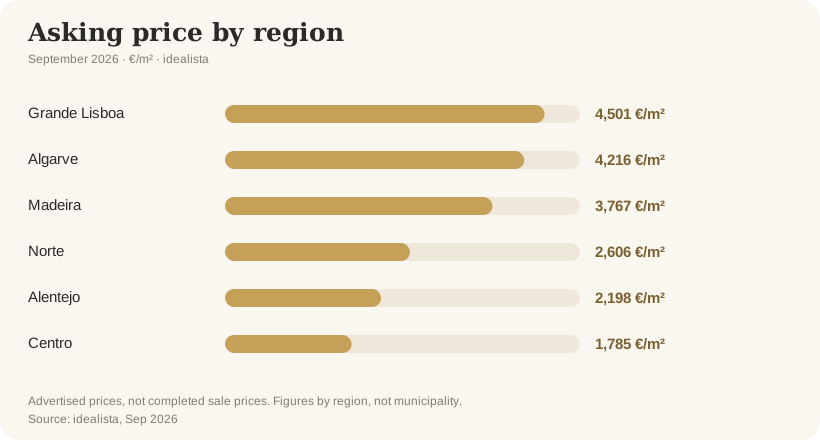
Well-located, energy-efficient properties with clear documentation are more resilient. Overpriced homes with significant renovation needs face greater risk.
5. What about rents?
Advertised rents rose 6.1% year on year in September 2026 (idealista). I do not expect major nationwide rental relief without a substantial increase in supply.
6. Mortgages and affordability
Average interest on new Portuguese housing loans was around 3% in August 2026 (Banco de Portugal). A Reuters poll on 8 October highlighted expectations of ECB rate rises; this was a forecast, not an official decision (Reuters).
For a €250,000 mortgage over 30 years, approximate monthly payments before insurance:
| Interest rate | Monthly payment |
|---|---|
| 3% | €1,054 |
| 4% | €1,194 |
| 5% | €1,342 |
7. Bubble risk is real, but a crash is not certain
UBS placed Lisbon in its elevated bubble-risk category in September 2026 (UBS). The IMF estimates overvaluation of 20–40%, but that is not a forecast of a 20–40% price decline (IMF). A slower market and local corrections are different from a full financial crisis.
8. What could change the outlook?
- How quickly new housing reaches the market.
- Foreign demand: non-resident tax households accounted for 4.7% of purchases in Q2 2026, down 10.3% in number year on year (INE via idealista).
- Mortgage rates, incomes and inflation.
9. My updated 2027 outlook
Base case
+2–6%
Growth moderates while supply remains tight.
Adverse case
−5–0%
Higher borrowing costs and weaker demand force some discounts.
Strong market
+7–10%
Resilient demand meets very limited supply.
| Relatively likely | Still uncertain |
|---|---|
| Affordability remains difficult | The precise rate of price growth |
| New supply takes time | Where interest rates will go |
| Local markets diverge | Which locations may correct |
| A fair asking price matters | The impact of new housing measures |
10. What buyers, sellers and investors should do
Buying to live
Do not count on a major crash, but do not buy out of fear either. Focus on a comfortable mortgage payment, comparable properties, legal checks and a long enough ownership horizon.
Selling
Do not mechanically apply last year’s market growth to your asking price. Study competing listings, prepare documents and set a realistic initial price.
Investing
Run the numbers assuming no capital appreciation for several years. Rent should make sense after tax, maintenance, vacancies and other expenses.
My conclusion
My baseline is a slower and more selective property market in 2027, not a guaranteed nationwide collapse. The specifics of each property matter more than a single national percentage.